About Fanchento
Fanchento Kung Fu and Ju Jitsu is a traditional non classical system of martial arts drawing on Chinese, Japanese and modern holistic philosophies.
Martial arts systems are usually described according to their roots: their philosophy and their history.
Philosophy
A number of ideas infuse and inform all aspects of Fanchento training, the most important of these are:
(a) Cultivation of individuality
The overriding principle of Fanchento is:
Cultivation of individuality in Body, mind and spirit
There are 2 aspects to this:
Firstly, training is grounded in the reality of combat but not focused on combat. It is directed, as any true art is towards self cultivation. In the words of Grandmaster Davidow:
"Its madness to train your whole life for a fight that may never happen"
 Secondly, unlike, classical martial arts which force students to all learn the identical material, making students clones, Fanchento follows the idea of Bruce Lee that: Secondly, unlike, classical martial arts which force students to all learn the identical material, making students clones, Fanchento follows the idea of Bruce Lee that:
"The individual is always more important than the system"
Every practitioner is different and as such needs to find the right techniques and way to train for him/ her.
(b) Principle based training
A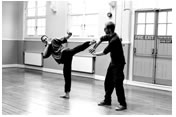 fter investigating many different martial arts Bruce Lee realised that stripped of their cultural idiosyncrasies there were fundamental principles common to all. fter investigating many different martial arts Bruce Lee realised that stripped of their cultural idiosyncrasies there were fundamental principles common to all.
We are a principle based system and practitioners are always fully aware of the principles behind an exercise or technique, as all exercises are expressions of these underlying principles, practitioners are constantly exploring these ideas in various contexts. In the words of Master Davidow:
"learn everything [because the principles are contained in everything] but master one thing [ because if we focus our attention on one technique it will be easier to master]"
By learning the correct way of breathing when I practise one technique, I learn the correct way of breathing when I practise any other technique of that nature.
By under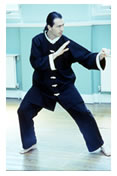 standing the principles behind every movement, training always takes place on at least 2 levels, the technique level and the "meta" or principle level- this allows students to progress at a geometric rate. Further, this creates an intellectual and emotional enthusiasm for training which further accelerates progress. standing the principles behind every movement, training always takes place on at least 2 levels, the technique level and the "meta" or principle level- this allows students to progress at a geometric rate. Further, this creates an intellectual and emotional enthusiasm for training which further accelerates progress.
History
I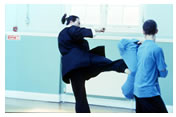 n the history of all fields there are giants that stand out as having revolutionised their art. In martial arts such figures include Jigoro Kano (the Japanese educator who founded Judo) and Bruce Lee (who revolutionised and released Chinese martial art from the stifling affects of empty forms). n the history of all fields there are giants that stand out as having revolutionised their art. In martial arts such figures include Jigoro Kano (the Japanese educator who founded Judo) and Bruce Lee (who revolutionised and released Chinese martial art from the stifling affects of empty forms).
Kano's art was passed down to Mickey Davidow primarily from Jack Robinson and Msumoro Saganji.
Edward Liang was a classical Kung Fu instructor who was heavily influenced by Bruce Lee's concepts, he passed his teaching directly to Mickey Davidow.
Mickey Davidow taught many thousands of students over 60 years. Many of his students became Judo champions and others developed their own highly acclaimed systems.
One of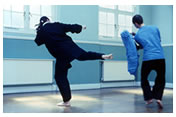 his private students, Marc Kahn opened the Rhodes University Martial Arts School where his teaching was informed by his study of body orientated psychology. In addition to training directly under Grandmaster Davidow, Marc trained with the Chinese Shao Chiao champion who lived for many years in South Africa (Nicknamed "Merlin" for his incredible healing powers). his private students, Marc Kahn opened the Rhodes University Martial Arts School where his teaching was informed by his study of body orientated psychology. In addition to training directly under Grandmaster Davidow, Marc trained with the Chinese Shao Chiao champion who lived for many years in South Africa (Nicknamed "Merlin" for his incredible healing powers).
For further history of Fanchento and Kung Fu please see the international fanchento web site www.fanchento.com

|
|